As an economics student going into IB, I along with many friends will be studying and revising to be well prepared for our continued studies when the academic year begins. As an avid reader on the subject I created this list of timeless classics which if read carefully provide a solid foundation for a thorough understanding of the subject, a list of books I will also be revisiting. Students, laymen and experts alike should check out the titles in this list, for an introduction into economic theory and mechanics. It is a far from perfect, but should be more than sufficient for anyone interested in the subject who wanting a thorough introduction to the discipline.
- The Wealth of Nations – Adam Smith
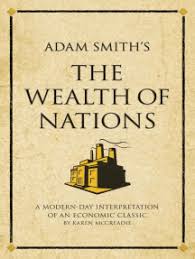
There’s no doubt you would have heard of this classic which gave birth to the modern field of economics, but I guarantee you that your takeaways from this book will be much, much, more than your understanding of economics, at least in the way one normally perceives the discipline. Adam Smith, was more than an economist, he was a moral philosopher, and probably one of the greatest intellectuals of his time, bar none.
Fundamental ideas we hold to be true in modern economics were first extensively elucidated here, such as: individuals are driven by incentives, prime among them being self-interest, and it is this self-interest, along with trade, specialisation and the division of labour that ensures disparate individuals with varying vocations, such as the tailor, baker, carpenter are each sheltered, clothed and fed.
The idea that wealth is labour and not merely bullion or currency that represents wealth, is thoroughly explained as more precisely being the product of knowledge or skill to create fruitful labour; and that in an ideal system one should own the fruits of one’s labour in order to be motivated by the profit of trading that labour, to align one’s own interests to the interests of others, or in other words, maximise the value of one’s goods and services to others, to maximise wealth creation in a competitive marketplace.
Moreover, that this system of free exchange and trade, is the only that can effectively create wealth, and exists to whatever degree that coercive authorities, namely government, have “laissez-faire” policy, not intervening in it’s people’s rights to live and work freely, and having a right to private property.
This book is foundational, and a timeless defence of human freedom, ingenuity, and the natural order of human societies given freedom from arbitrary control. Our modern understanding of human societies let alone economic theory, would be incomplete if not for the contributions of Smith.
- Capital – Karl Marx
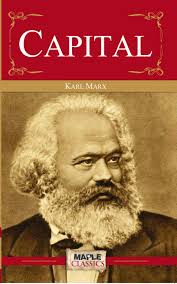
Marxism was the inevitable response to laissez-faire, free market capitalism, that developed ensuing the innovations in thought by classical economic thinkers like Smith among others. A flawed ideology in many ways, riddled with fallacious argumentation and inaccurate evidence in support of it’s claims, Capital remains a classic because of the political and philosophical impact on the world ever after.
To be read critically, Capital and the ideology of Karl Marx and his primary collaborator Friedrich Engels, contains one of the oldest criticisms of accumulating capital in any economic system ever. A principle as old as the Bible found in Matthew 25:29,
“For to every one who has will more be given, and he will have abundance; but from him who has not, even what he has will be taken away.”
Often called the Matthew effect due to it’s biblical origin, popularly known as the adage, “the rich get richer and the poor get poorer”, this has a grain of truth, to a very small degree. The rate at which capital grows, usually outpaces the growth of an economy, on average, a point we may get to on another date. This phenomena well documented, in the recent bestseller by Thomas Piketty, Capital in the 21st Century, illustrates how wealth inequality naturally emerges from unique properties of accumulating capital due to it being a resource in itself.
The essential meaning of all this is that, those with inherited wealth or in Marxist terminology, “control over the means of production”, will perpetually increase their ever-increasing wealth due to their pre-existing control over the forces through which societies become richer, in the process, impoverishing the poor due to labour exploitation. This doesn’t seem to have been borne out by the last few centuries of human history; as societies get more prosperous, the rich get richer and so do the poor.
However, Marx does one thing well, which is focus on this problem of wealth inequality from a rigorous economic perspective, largely unaddressed previously, and a cause for growing social tension between the classes due to growing disparity. Critics say focusing on inequality for its own sake is unjustified, and the reduction of poverty should be the goal, not wealth inequality, and they may be right. But Marx without a question tapped into a popular sentiment that survives to this day, in some forms or the other, and a study of economics would be unfinished if Marx were neglected.
- The General Theory of Employment, Interest and Money – J.M. Keynes
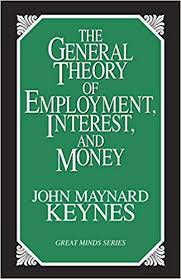
As relevant today as it was close to a hundred years ago in 1936, when first published. John Maynard Keynes, is probably single-handedly the most impactful economist of the last century due to his impact on the policy making of world governments, and it is in large part to his magnum opus, The General Theory of Employment, Interest and Money.
An extremely fitting book for the times we live in, it was originally written amidst The Great Depression, the worst economic depression ever recorded, until possibly this year, 2020, in large part due to the catastrophic blow dealt to the world economy because of the coronavirus pandemic. Keynes wrote his General Theory, as a response to The Great Depression, in fact rather a prescription to the field of economics, and governments in the west, to take active part in the managing of the world economy to combat the impacts of the depression they were living in the middle of.
His central thesis was that depressions occur due to a fall in aggregate demand, and that it requires massive fiscal and monetary stimulus on the part of government to revive a dying economy, restore consumption of goods and services, and lift a country out of depression and once again into growth. I must warn you however this is a simplistic caricature of the book. But please don’t expect much more of me, it’s hard enough as it is to explain Keynes! Go read it!
The eponymously named Keynesian school of economics that Keynes cemented through the publication of this book is beyond any doubt the most influential school of thought of the last century. Keynes prescriptions for a dying world economy was taken seriously by policy makers around the world for generations, and most widely used to combat The Great Recession which ensued from the financial crisis of 2007-2008.
Probably the most celebrated economist of his generation, The General Theory is a must read for any aspiring economics student, and elucidates much on the nature of business cycles, recessions, depressions and how to stop them.
- The Road to Serfdom – Friedrich Hayek

The definitive rebuttal to Keynes, Hayek established the pre-eminence of Austrian school thinking among liberterian and conservative circles around the world for generations, due to this book The Road to Serfdom, a magnificent treatise on political philosophy and economics. Famously, Margaret Thatcher when setting her agenda in Parliament as she first entered office, slammed Hayek’s “sequel” to this, The Constitution of Liberty, and proclaimed “This is our manifesto!”
Confronted with the trend of planned economies and a top down approach to managing a society’s resources, distribution of wealth and production, while Europe, the US and the rest of the world were engaged in WW2, Hayek wrote The Road to Serfdom as a defence of market economy, and liberalism. State control of every aspect of life was becoming normal due to the extraordinary circumstances of WW2, and was becoming a a popular sentiment, due to the supposed successes of this approach during wartime. However, Hayek set out to show the importance of traditional market economies that were a great and recent innovation in the west, setting forth the practical and moral arguments against the invasion of the rights of individuals to liberty, property and free enterprise.
In fact addressing the supremacy of the state over the individual in general (the true meaning of ‘socialism’ according to Hayek), was an even larger trend—as seen by the fascist “National Socialists” or Nazis in Germany, or the communist government of the Union of Soviet Socialist Republics— a few variations of state empowerment that Hayek addressed (all falling under the umbrella of socialism, or state control).
Hayek, described in The Road to Serfdom, indeed what ideas make a people reduced to ‘serfdom’, mere slaves, and instead put forth the classical liberal tradition as an alternative. He defended the price system to trade goods and services, as the only possible system where the knowledge of millions of people could be input into the true value of a good, in what he called a bottom up approach to determine the priority in which items should be produced. The more the need for a good i.e. demand, and the less the ready availability, i.e. supply, markets would automatically facilitate increased profit for whichever individual created more of that good until eventually the profit would reduce as supply met demand, reaching equilibrium, and thus disincentivizing further production of that good (in excess, creating waste).
Hayek’s warning that when we cede economic freedom, our political freedoms are not far away, is ever relevant. He very importantly describes how economics plays a role in driving people’s lives, and describes the right way any economic system should be built, through this book. Another classic text, that revived Smith, opposed Marx and was influential for those who put freedom above all else. You will not go wrong in studying this book.
- Economics in One Lesson – Henry Hazlitt
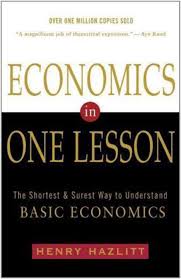
Lastly, for a book which is perhaps, the easiest, shortest and most straightforward read out of the list of books I have recommended so far, Economics in One Lesson, is as the title suggests an interesting take on the study of economics through one key lesson:
“The art of economics consists in looking not merely at the immediate but at the longer effects of any act or policy; it consists in tracing the consequences of that policy not merely for one group but for all groups.”
The book was instrumental in challenging my assumptions about economics and is bound to challenge yours. Whether it’s the unintended impact of tariffs, the side effect of rationing that price controls create on whatever good it is imposed on, and the mistakes of monetary inflation that makes itself felt slowly and over time, Economics in One Lesson, is the best guide for the layman to understand how an economy works and what the various levers and controls, public policy makers have access to, and the impacts of these policies in real life.
Hopefully you enjoyed reading this list of recommendations, and the quick summary/analysis for each book, on why the ideas contained within them are so important. I promise you, if you read each of these great works, you will have a thorough introduction to economics, be it IB economics for someone like myself, and beyond!
 The Candid Contrarian