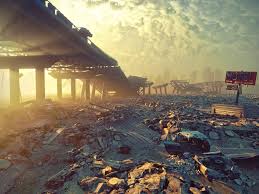
“We are now gods, but for their wisdom.”
Eric Weinstein
Over the last 6 months I have had to take pause to really process that something as catastrophic as a viral pandemic, is not just the stuff of spectacular, explosion filled, Michael Bay movies, but a genuine, hard reality. Looking at the economic impact of worldwide lockdown, the recent unrest and rioting in America on a massive scale, and the burdensome load on our global scientific community to rapidly develop a lasting solution to solve the coronavirus problem, it seems reasonable to assume that serious disruption is becoming a frequent phenomenon, or at the very least suddenly appeared to be so this year. I would argue however, that the disruptive force of these events haven’t just been in play in the last year, but has been a growing trend that has been developing over many decades. It appears that there will always be another 9/11, subprime mortgage crisis, Arab Spring, or now—viral pandemic—right around the corner when we least expect it.
The impact of these highly improbable, yet highly impactful “Black Swan” events (a term coined by Nassim Taleb, a personal favourite thinker, who’s ideas we may go into more deeply in another blog post/posts), seem to be increasing in frequency and destructive potential with time. Is this definitely true, and if so why is this the case? Why is it that we’ve become used to these rare and infrequent, yet progressively disastrous events? Why doesn’t the massive progress we see in all other domains of life fail to address the complexity of the new problems we encounter, when humanity becomes as interconnected and interdependent as we have become? What does our future as a species look like, given that despite our innovations in technology and science, we can’t stop freak events that totally disrupt an otherwise optimally functioning system?
A physics analogy which is particularly helpful to me, to try to understand the real unintended impact of the complifying effect that human progress has made over centuries, especially in the last one, is the dichotomy between kinetic and potential energy in any given system. If my objective is to roll a boulder up a hill and keep it there, I expend massive energy doing just that, which is kinetic in nature. It reaches the peak, may come to a stop, and stay in the desired state of rest; however, it only requires a miniscule use of force to push the boulder off this peak, and for it to experience the violent force of gravity as an expression of it’s stored potential energy.
This is analogous to the exponential power of technology and the globalising forces we have experienced as a species in a relatively incredibly short period of time, that makes us more vulnerable to rare catastrophic events. Since around the development of the atom bomb nearing the end of WW2, the day-to-day negative ‘kinetic energy’ or the natural causes of human suffering inherent to the human condition has continued to massively reduce, at the cost of increasing the potential energy for disaster in the system. The decline in the so-called ‘kinetic energy’ comes from a reduction in war, poverty, crime and disease, due to the advancement of technology, science, and ideas about human freedom. This accomplishment is not to be glossed over, as undoubtedly we live in objectively the best time to be alive, all things taken into account. In the last century, we have uplifted the material well being of millions to liberate the human condition of absolute poverty, the developing world has caught up with the west extremely rapidly after experiencing industrialisation in the last 7 decades, and the computer revolution led into our modern information age starting in the ‘80s and ‘90s, is forever changing us all. All of this however positive as it may be, I would argue comes at the cost of massively increasing the negative ‘potential energy’ as I described it in the previous analogy. The risks built into our global system that make humanity increasingly vulnerable to singular high shock events affect the newly globalised world much more than ever before, the best living example being this coronavirus pandemic we’re all living through.
Here’s an example: technology improves rapidly to the point our weapons can destroy the planet a 1000x over (already achievable with nuclear bombs technically), but here’s the catch; the cost of production for this destructive force becomes multi-polar ensuring not only that the destructive potential far exceeds anything we can imagine, but it becomes easier and easier for private corporations, terrorist groups, and even individuals to obtain humanity destroying tech. This may seem far-fetched, but it really isn’t. If you assume any rate of technological progress, and have an endless time scale (presumably because you assume humanity won’t destroy itself ever) we will reach this scenario one way or another.
So how do we solve these future problems facing us? As far as I can tell there seem to be two schools of thought (broadly speaking), we can call them the techno-optimists, and the Doomsday prognosticators, the latter being more wide-ranging with both a moderate and true pessimistic faction.
The moderate faction of the pessimists, Elon Musk especially, believe that humanity absolutely must become an interplanetary species as soon as possible and be prepared in time to enter into a symbiotic relationship with AI when machine consciousness is inevitably achieved. If these two things, as well as the aversion of massive climate disaster is averted, we may be somewhat secure in the continuation of civilisation, because our symbiosis with AI, and establishment of human colonies on other planets, will transform us a species, in the process evading the other potential obstacles for humanity’s progress. Clearly Elon for one is working towards this goal, and making valiant efforts to “get off Earth” as he puts it, with SpaceX, and also active in the AI front with his company OpenAI. As a side note, it’s for this reason, that I deeply respect Elon. At the very least, the man puts his money where his mouth is, and as an entrepreneur has entered exactly into the crazy fields where he believes he does civilization the most good (his self-declared ultimate purpose), while also cashing in and making billions in the process!
Anyhow. If this is what needs to be achieved according to the moderate Doomsday prognosticators (Elon Musk especially), that we must become a space-faring civilisation and harness artificial general intelligence to secure our long term future—short order huh—what about the true pessimists? The short answer is, the order gets taller. These two conversations between the MD of Thiel Capital, Eric Weinstein, with Daniel Scmachtenberger and Ross Douthat, respectively, illustrates the problems ahead perfectly, and have personally shaped my thought on the subject greatly (and given the name for this article!). According to this faction of the Doomsday crowd, we are indeed truly doomed, unless we mere humans figure out the theory of everything for fundamental physics and understand our source code? Maybe?
The problem envisioned by the pessimists is firstly, the Einstein speed barrier (theoretical limit on speed prohibiting faster than light travel), which makes tech billionaires like Musk betting big on space look foolish since we can never practically leave the solar system, only leaving us with Mars (which is of course Musk’s goal). The only problem is, there’s nothing on Mars, and it’s doubtful whether it can be a long term alternative to inhabitation on Earth. The only possible way to get out of this dilemma would be to fundamentally transform our understanding of physics. Which brings us to the second problem of the pessimists. If destructive power becomes distributed across a population, it is not necessary that the population will implode. As long as there is a critical mass of good actors, catastrophe can be stopped. But history teaches us when there is no growth, no mobility, nowhere new to go too, social conflict arises. If one analyses civilisations throughout history, all of them have either transformed or come to an end, and these transformations keep the societies stable by ensuring growth for its people (by either conquest or innovation).
To summarise the counter-argument of the pessimists, I would cite the techno-optimists, especially Steven Pinker and his 2018 bestseller Enlightenment Now (which Bill Gates called his favourite book ever in his review of the title). According to Pinker and many others, human ingenuity coupled with the exponential nature of technology has solved and will solve a lot of human problems. Whether it was the development of the Baconian scientific method, the revolutionary progress in medicine that has doubled life expectancy, or technological innovation that led to the industrial revolution, if we value reason, science and humanism, we will continue to see great progress, and be able to adapt to the problems of nuclear conflict, AI and space exploration. Yuval Noah Harari, has argued the same in his many publications after the initial success of his book Sapiens, his central idea being that the problems of globalisation and exponential technology can be solved by a realignment in the grand narratives of different societies to establish global governance structures that will be able to avert ecological disaster such as climate change, nuclear proliferation and even natural or weaponised pandemics. Things have been getting better for human beings around the world for very good reasons, and there’s no reason humanity won’t be able to use the same tools we have used to bring us here, to overcome whatever adversity we may have, according to the techno-optimists.
Ultimately, the question still remains on how we pesky humans will deal with the growing complexity of our problems, without ignoring their existence simply because material progress has been great in many other domains. Things aren’t as they used to be for better or for worse. We have “attained the power of the gods without their wisdom”, and it’s to be seen whether we will fundamentally transform ourselves to transcend our problems or face total annihilation. I’m going to be optimistic.
 The Candid Contrarian