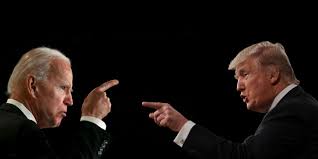
As another election cycle approaches for the US Presidential elections, and candidates from both major parties remain largely unsatisfactory to the electorate outside of their own voter bases, the perennial question persists, whether or not a third party candidate can successfully run for President of the United States and win?
Regardless of one’s political leaning, there is no doubt that a binary choice for electing the world’s most powerful leader is a ridiculous notion. While not the only reason behind increasing polarisation and divisiveness in the US, the two-party system most definitely plays a major role in eliminating moderation in politics, with centrism being overlooked in a race to the bottom where each political party becomes more extreme to appease their own base.
There are many, many reasons why the two-party system dominates American democracy, notably the way Presidential Debates are organised making it impossible for third parties to break into the system, and into the public eye, not to mention the nexus between mainstream media and establishment politicians, the entrenchment of various institutions to disallow political outsiders, etc. But how did this system come to be in the first place, and what can be done to fix it?
The Westminster System vs. Presidential Democracy
Most of the world’s democracies outside of the United States, practise British Parliamentary democracy using the old Westminster system, wherein the head of government or Prime Minister is not directly voted for by the electorate. In this system used here in India as well, the leader of the political party with a mandate in the country’s principal legislature or Parliament forms a government. Notorious for their coalition governments, political horse trading and indecisive election results (think Theresa May in recent times!), many claim US styled Presidential democracy to be superior, as the chief executive is directly responsible to the people who cast their vote for him or her. But the same quality that makes the American system effective at choosing one leader with a strong mandate also prevents diversity in political representation.
The reason the two-party system has naturally formed in the United States is because there is no space for vote splitting and post-election alliances and coalitions. If my choice is between Republican nominee, incumbent Donald Trump and Democratic nominee Joe Biden, voting according to my conscience as a liberterian for the Liberterian Party candidate Jo Jorgensen (there’s a reason you haven’t heard of her), would mean throwing away my vote. If my goal were to vote the incumbent out of office, in this case Donald Trump, any effort to do so would mean compromising for his primary opponent, Joe Biden, despite our potential difference in values and beliefs. However in a parliamentary system, where I’d vote for a third party, let’s say the Libertarians, there would be a slim chance for me to at least have an MP in my constituency advocating for my values in government, regardless of this specific party’s popularity nationwide. They would have the opportunity to potentially ally with opponents of the current administration to form a viable government, even if they themselves are not in majority in Parliament. The present situation however dictates that I’d be splitting opposition votes to the incumbent by voting for a third party, and actually be supporting my political opponent.
First Past the Post vs. Ranked Choice Voting
Although a simplification of both systems of representative democracy, with the Presidential and Parliamentary system having many other noteworthy differences, the primary one remains that with the latter form, political diversity emerges more naturally. However, does this mean America is doomed to it’s fate of partisan politics with only two sides to every argument?
The simple answer is, no. America can keep it’s Presidential system, without changing the electoral college, it’s constitution or the fundamental nature of the Union. Without arguing the merits of America’s electoral college system versus a popular vote system, due to American federalism at the core of the American system of government, there is a way to open up the political process to third parties without abandoning the protections the electoral college provides in stopping majoritarian mob rule (where 51% of the country can control the other 49% simply because they’re in majority).
Here’s how: the current voting system is one where states decide how the electors they are assigned in the electoral college vote in choosing President. Currently, if the Republican incumbent Trump won a plurality of the popular vote in Texas he would have the support of all 38 Texan electors in the electoral college. If Democrat Joe Biden won a plurality of the vote in California, he would have the support of all 55 Californian electors in the electoral college. This is the first past the post system; whichever candidate wins the most number of votes, wins the state, reinforcing the binary choice problem of the two-party system. However, if the states decided to change how their electors voted in the electoral college, by instituting something known as ranked choice voting, a voter would be able to list in order of preference, which candidates they would want to vote for. Through this, they would not be throwing away their vote if they listed their first preference as a third party candidate, yet still had the option to list the lesser of two evils out of the other mainstream candidates as a second choice. If the third party candidate won, they won, if not, the voter still made an impact on the elections.
The Political Outsider: Can the System Be Reformed From the Inside?
The fact of the matter is, ranked choice voting or any of the other number of electoral reforms proposed in the United States have very little chance of being actually implemented. The two major political parties are not going to give up their monopoly on power by proactively pursuing reform anytime soon, regardless of their potential to fix American politics. So, is there any room for hope?
The two most notable things about the 2016 and 2020 US Presidential elections have not been the two Democratic Party candidates, Hillary Clinton or Joe Biden. They have actually been the Democratic Party runner’s up both election cycles, Bernie Sanders, and the Republican nominee in 2016 and current President Donald Trump. Where Sanders failed, Trump succeeded. By taking down the establishment in the Republican Party, and representing the disgruntlement felt by the American working classes at the state of the American economy, foreign policy and the elitist culture who ignored their concerns in the flyover states in the middle of America, the electorate rewarded Trump for representing a populist backlash to perceived stagnation in the American political system. Sanders, while attempting to do the same despite failing to succeed in the short-term, irrevocably changed the Democratic Party regardless, and represents the wave of the future. The two-party system is breaking down in front of our eyes.
Donald Trump’s personal unpopularity may temporarily reverse the populist tide overcoming America, especially because of the unique circumstances of COVID-19, and it is entirely possible that we may see a Biden presidency that is a return to political normalcy. But it would be unwise to ignore the growing sentiments for change all throughout the political spectrum. Whether or not structural reform allowing for active participation of third parties is seen or not, the rise of political outsiders within the current system is inevitable.
 The Candid Contrarian