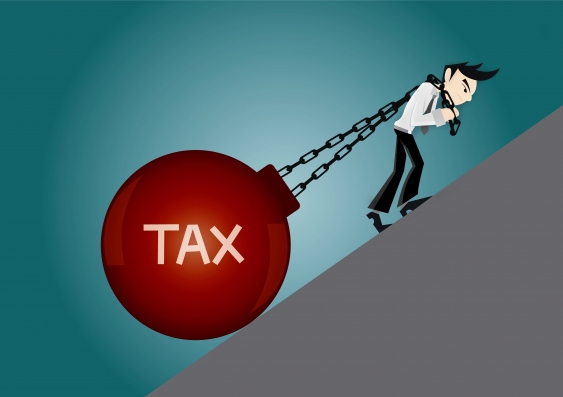
According to the best estimates, 120 million people in India have lost their jobs due to the economic impacts of COVID-19, and nationwide lockdowns, with many more facing severe pay cuts. Right now, resources are scarce, especially financial resources. Families have to make compromises and huge lifestyle changes, and when each rupee makes a huge difference, a large chunk of it is paid to the government in overwhelming taxes. Direct income tax rates on average, have been on the rise, and in 2020 they hit a whopping 35.88% for the highest tac bracket. That’s over a third of your money!
Before we get into the realities and issues with direct taxation, it should be noted that despite it’s limited scope the Income Tax Department of India is evaluating 750,000 cases per week (they started 8 weeks ago), for potential eligibility of tax rebates. This is a commendable effort because it can make a huge difference for many families, yet is still not enough.
There are multiple kinds of taxes, but they can be split into direct and indirect taxes. Direct taxes include income, wealth, gift, estate, etc. These are the taxes that are directly put on an individual income. Indirect taxes include the goods and services tax (GST), tolls, etc. In this case, an individual can pay the tax of many people, but ultimately that has been collected for each and every customer.
Is progressive income tax, regressive? The money you earn, is through your own hard-work and dedication, so how is it justifiable for the government to bear the fruits of it? In a way, it disincentivizes hard work and motivation, because the more you earn the more you pay. And that is a very dangerous thing. A growing economy like India needs more enterprise, and if it isn’t worthwhile
But the tax money you pay helps develop the country, right? Yes, but inefficiently. The government essentially re-allocates money, and puts it back into the economy. And this is inefficient as the more hands it changes, the more opportunities there are for embezzlement and corruption. Instead, the money you pay to the government could instead be additionally money for you to spend. For example, this could support local businesses, which would mean reducing the need for subsidies paid by the government. The more disposable income you have, the more likely you are to spend it, and the more you spend, the more the economy benefits.
But then who pays for the infrastructure? What about healthcare? Benefit programs? As I mentioned earlier, indirect tax money is also huge. And because of the increased spending, this would also increase. The GST could also be increased, but progressively. This means basic necessities and commodities would have lower GST. Making it more accessible to the people that really need it. And for luxury products, these taxes could be increased, which in a sense would replicate the concept of progressive tax. This would be quite fair, as the poor still pay less tax, while the rich pay more. And it would be significantly better than progressive income tax.
Progressive income tax (based on tax brackets) means that the greater income you have, the more taxes you pay. On the surface, this may seem fine, the more money you have, the more you should pay to the government, but it’s actually an injustice. Not for the upper class, but for the middle class. The realities of the situation are that the rich can use tax havens, pay bribes, and effectively evade taxes, while the lower class don’t pay taxes altogether. What ends up happening, is that the middle class is treated unfairly, and in times like these, they’re the ones most affected.
A side benefit, which is still quite significant, would be inviting people into India. Corporations and individuals would be attracted to India due to the reduced taxes. This would boost employment, and tremendously help the economy.
Abolishing direct taxes is a multi-faceted problem, with many for it, and with many against it. In the context of India it seems to be viable, as a country ridden with tax evaders in the upper class, abolishing income tax would actually eliminate the concept of black money. And additionally with a government that many consider ineffective, the responsibility, and to a certain degree, the power, would lie in the hands of an individual. And personally, that’s much better.
 The Candid Contrarian