Our lives are driven by emotion. No matter how much we rationalize or reason, at the core of all of our actions exist emotions. An inherent desire to feel good, so much so, that it is built into our biology. The very idea of dopamine reflects this, and it is a major part of freudian theories of psychoanalysis.
Dopamine
Dopamine is called the “feel good” hormone. This neurotransmitter is primarily important in motor functions, but plays a major role in the brain’s reward system. Eating, drinking, and sleeping are all basic needs of humans. And dopamine plays a major role in reinforcing their importance. The pleasurable feeling of being full, or drinking water to satiate thirst, these actions release dopamine because they’re necessary for survival. The same thing applies to sex, as we need to reproduce to ensure that our species continues. And we know that they are necessary, not because we’ve been told, but because we’ve experienced the feeling in some way or another.
Dopamine doesn’t just end there. It is literally the driving force of what makes us move. The reason we get up to each lunch is not only because we’re hungry, it’s because we anticipate and want the satisfaction that it creates. While these aren’t inherently malicious, it can extend to other facets of our life and cause serious problems.
Instant gratification is also something that releases dopamine. And this becomes problematic because it isn’t limited to just a specific action. Even though there are drugs that mimic the effects of dopamine or even cause its release, this is far more subtle and far more dangerous. We have urges, we have desires, we have needs that need to be fulfilled, and the sooner they happen, the better it is. The more frequently they’re satisfied, the more we want them. This creates a dopamine reward circuit. This not only increases the satisfaction but manipulates the very fibre of your brain. Memories of such activities are considered more significant and have a greater emotional weight attached to them. This affects and commands your brain to do it again, even if you know that the activity is a bad thing.
The path from here to addictions is rather short. And is only enabled in the world we live in. It exists in the very nature of the age of information. Our curiosities are instantly gratified, because we have access to all of human knowledge right at our fingertips. The food industry has completely transformed form the advent of products like instant noodles, to the overwhelming presence of sugar, a highly addictive and dopamine inducing substance. It becomes more and more inconvenient to avoid these things, and we feel happy, pleasured, and satisfied when do them. So when the easiest thing is to feel good, how can we possibly not do that?
These things start getting built into our lifestyles, and are easily accessible to many. But what really causes the need to begin these circuits. I understand with things like food and information, that it becomes hard to avoid, but what about drugs and social media, things that we know can be really bad. The answer is silence.
When was the last time you sat alone for more than an hour doing nothing? Staring into the abyss, no music, no books, nothing. Every aspect of our lives has now adapted to being filled with some form of stimulation. It’s generally termed as filling up a void, but that has dark and negative connotations, but it’s honestly a part of human nature. Addictions and bad habits aren’t about a lack of self control, it’s about not being able to deal with emotions in the right way. It is far easier to trigger the pleasure center of your brain, than to directly confront what you face. That is what exists at the very core of addiction, something you want to avoid, something you feel that can’t be challenged, can’t be changed. And so the result is indulging yourself in pleasure, not to make yourself feel better, but to make the pain go away, however temporarily.
When dopamine levels are low they can cause depression, fatigue, and lethargy. That’s because there is no biological motivation to do even the simplest of tasks, even grabbing a glass of water. Even though having high dopamine levels is good for productivity, the method in which we achieve this is far more important. The most natural ways to do so are through eating the right things (protein rich, and low saturated fat), exercising, sleeping well, listening to music, meditation, etc. There are a lot of studies devoted to this, and I recommend checking them out (Captain Sinbad is a great place to start).
Pleasure Principle
Even if you had the understanding of the biological reasons why addictions are addictive, there is much more which is embedded into your psychology. Sigmund Freud had the idea of the id and the ego. The id is the most primal and instinctive part of your personality, it’s the only part that exists at birth. It is responsible for wanting to fulfill our desires, and has no inhibitions. This was the driving force of humanity for all but for a few millennia. Until civilization and the ego became prominent. The ego is the part that controls these urges, and keeps us in check. It provides the logic, and is the pathway between the unrealistic and unconscious id to the real world. Both want to seek pleasure and avoid pain, anxiety, or tension, but the ego wants to do it in the most rational way, which doesn’t cause harm to itself or the id. Forms of harm could include intangible things like reputation, and that is partly why it is considered to make us want to “fit in”.
One might compare the relation of the ego to the id with that between a rider and his horse. The horse provides the locomotor energy, and the rider has the prerogative of determining the goal and of guiding the movements of his powerful mount towards it. But all too often in the relations between the ego and the id we find a picture of the less ideal situation in which the rider is obliged to guide his horse in the direction in which it itself wants to go.
Sigmund Freud
These less than ideal situations are when it gets tricky. Take the example of social media, something that appeals both to the ego and id. The instant gratification of putting something up and get likes, comments, shares, etc. while at the same time to no harm of your reputation. Granted, the ego will prevent you from posting things that could hurt your image, but just really give this a thought. The fundamental desire for humans to get approval, and it can happen instantly, and for almost no tangible cost. So why not spend all your time here, receiving the likes, and thereby receiving the gratification, when you don’t lose anything?
Like all developing addictions there is a resulting dopamine reward circuit and that starts to become a huge problem. We seek the likes, and when we don’t receive them as soon as we expect to, its devastating.
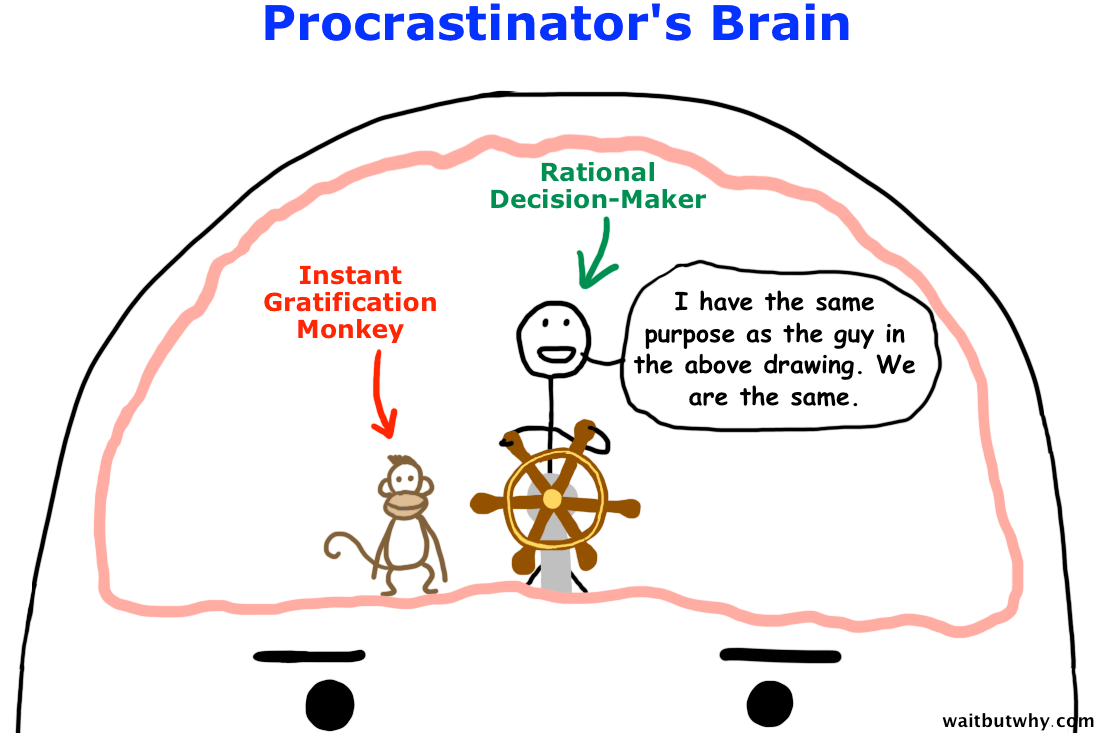
There is also another conundrum which the ego and the id present. When the ego has no rational or clear path to get the gratification, it results in anxiety and stress. And when that happens there are certain unconscious defense mechanisms that are triggered. This just happens to be avoiding the pain or whatever the problem is until the ego thinks of something. And how do we avoid things? through the power of instantaneous pleasure and gratification!
Procrastination
We’ve discussed how our psyches are closely tied to our biology, and how they both tend to have similar defense mechanisms. The defense mechanism of avoiding tends to be quite similar to procrastination, and often results in it. I wanted to specifically talk about what it is, why we do it, and ways to possibly overcome it.
Procrastination seems to be the malicious side effect when you combine two drugs at the wrong time. When our psyche and our biology seem to be working against our productivity it can be overwhelming. The worst part of this is the self-awareness. More of than not, when you’re procrastinating, you are aware of it, and you feel guilty, and yet you do nothing. Why is that so?
Typically, there are negative associations with the work you are procrastinating, for example if you feel the task at hand is way too tedious, stressful, or intensive. Normally, with things like eating or drinking, you’d have dopamine on your side, kicking you into action to get it done. But this time it’s working against you, the activity you’re doing to avoid the work is the one that is creating the pleasure, so why would you stop?
Dr. Piers Steel, a professor of motivational psychology at the University of Calgary, calls procrastination a form of self-harm. That makes sense in a way. Engaging in an activity we know will have negative consequences for no one but ourselves. Prolonging the negative emotions that come with the work, and adding on stress and anxiety about not doing the work itself on top of it. And this is all while we’re completely self-aware, in the moment. This shift in perspective makes procrastination not a problem of time management, or just a personality trait, instead it becomes about emotions, and their regulation. In all honesty, it may seem like it makes the problem of solving procrastination all the more difficult? So why even bring it up?
Before I even answer that question, I want to talk about my own experience of this. In writing this very article. I didn’t procrastinate because I felt the need to do it later, or that I was just too lazy. No, rather it came from a certain self-doubt, of whether I even had the ability to talk about something so complicated in a coherent way. I’m not a psychology student, and was worried that this would be out of my depth, so I put it off, for far too long. And that just created an impending sense of doom, “oh no! I won’t be able to get this done on time!” So essentially, the work that was stressing me out, I postponed it, to do something a little more pleasurable, but that only cause more stress, causing it to get postponed even more. This is just my thought process, but I’m fairly certain a lot of you may have experienced the same.
Now, back to the main question, why is it important to acknowledge that my procrastination is not an issue of time-management, but of emotional regulation? To answer this, we can bring it back to the main point, of addictions and instant gratification. These are both coping methods of the very same thing that causes the procrastination, and it becomes much better to address all three at the same time. Take the problem out at its very root. And by no means is this an easy task, and it’s almost like saying, “hey if you want to stop smoking, just stop!”. But I think the process of combatting the very nature of your being is through self-realization. Being aware of your problems stops you from making excuses. And just the fact that you know you can do something about them, can sometimes be enough to start.
 The Candid Contrarian
One thought on “There’s No Satisfying the Instant Gratification Monkey”