
The death of Sushant Singh Rajput has captured the imagination of the Indian public for the past 4 months, since that fateful day, June 14th; the day the Bollywood actor was found dead in his Bandra home. The nation’s attention and reaction to the case however has become larger than the death of Sushant itself, with the entire country’s response indicating vulnerabilities in our society’s ability to make sense of the world and respond to crises and tragedies.
The public reaction to Sushant’s death has been characterised with rampant speculation due to cognitive dissonance, rampant hypocrisy in both the Bollywood fraternity and out due to selfish interest, and rampant sensationalism in the news media due to the perverse incentive structure of modern day journalism, making it harder for the ordinary person to distinguish between fact and fiction.
Here are the ways in which the unfortunate death of Sushant Singh Rajput has been politicised and has exposed the weaknesses in our collective institutions:
- Conspiracy theories are born from cognitive dissonance – Why do human beings create and believe in conspiracy theories? Were the moon landings faked, was 9/11 an inside job, did Lee Harvey Oswald act alone in killing JFK?
The intricate and grand conspiracies surrounding the death of Sushant whether true or not will only be borne out by investigation from law-enforcement authorities; however the public speculation over the wildest possible scenarios surrounding the incident do give rise to the question: why are we doing all this?
In psychology there exists a term for the discomfort and stress caused for having to believe seemingly inconsistent and contradictory things, known as cognitive dissonance. Oftentimes conspiracy theories arise when a society has shared cognitive dissonance over major events taking place in the world that seemingly don’t make sense.
Man on the moon? Impossible, has to have been faked.
Two jet planes flown into the most iconic buildings on the globe? No way. That couldn’t have been orchestrated by some obscure terrorist group somewhere in the Middle East.
The young, charismatic, president JFK, most powerful person in the world, shot by one single lunatic? The CIA, military-industrial complex or mafia; someone else has to be involved in this story.
In this manner, the cognitive dissonance we felt as a society when we heard that a handsome, successful and extremely intelligent young actor like Sushant took his own life did not make sense and was too inconsistent to comprehend. Hence we assumed there had to be more to the case, a grand conspiracy to shut him out of Bollywood, to end his career, to make him dependent on drugs. All of these may or may not be true, but instead of properly dealing with the very real possibility that sometimes people who suffer from depression may seemingly look happy and perfect yet still have to fight their demons and struggle with mental health, we skipped over this discussion.
- Due process for me but not for thee – The second way in which the public reaction to Sushant’s death has been unhealthy has been the seemingly inconsistent standards applied by eminent personalities both inside Bollywood and out.
Although the due process of law is the cornerstone of a just legal system and a fair society, the changing ways in which it has been applied raises the question of whether or not we care about due process, or just use it selectively when it suits our needs? As individuals have come out in support of Rhea Chahkraborty and opposed the harassment she has received from the public and media, due to her trial by public opinion and presumption of guilt without much hard evidence as of yet, will we so easily forget all the times we tried to cancel celebrities for less?
Notably, in 2019, the television actor Karan Oberoi was falsely accused of rape, in a corruption of the MeToo movement by his accuser, to extort him and exact vengeance. Was Oberoi given the presumption of innocence, or was his reputation lynched in the media until finally the truth came out?
On the other hand, just today, accusations came out against the Bollywood director Anurag Kashyap for sexual harassment, yet members of the film fraternity including prominent actors like his ex-wife Kalki Koechlin among others, have come out in support of him, flouting their own rules, of, “Believing all women”, and avoiding victim-blaming.
Due process is undoubtedly a good thing. The presumption of innocence is necessary as the burden of proof should not be on an accused to prove his innocence but on the accuser to prove his guilt. Trial by the mob and public opinion is also clearly wrong, and not the most effective way to impart justice and find truth. Yet the rules of the game have already been set, and it is disingenuous—no hypocritical—to believe that social media virtue signalling on either side is going to stop.
- Journalistic scrutiny or chasing TRPs? – This leaves us with the responsibility of journalists. We have almost grown used to social media frenzies and Twitter mobs in this modern age, but what part has the traditional, mainstream media had in all of this? What’s the balance between journalists doing their job and scrutinising the rich, elite, and powerful, compared to being judge, jury and executioner in exercising their power over individuals?
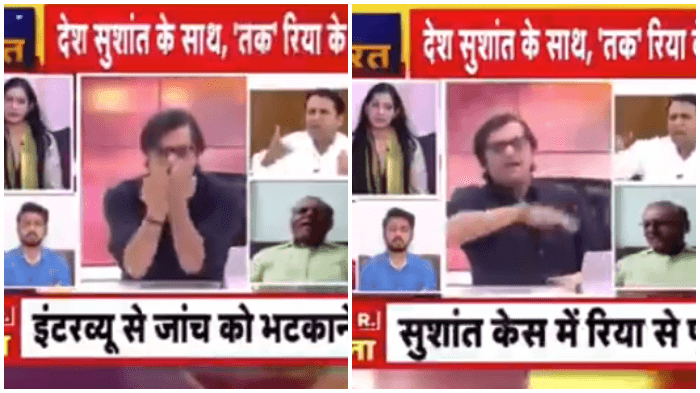
Journalistic ethics is a subject unto itself, but there’s no doubt that 12 panelist screaming matches on primetime TV, is a recipe for disaster. We’re seeing a rise of “infotainment”, where our evolutionary instincts developed to make us seek out information, is overstimulated in the information age, with noise and nonsense. Our addiction to “feeling” informed, not actually being informed, is endemic and seriously concerning as our news media is engaged in a race to the bottom. Serious, long-form, investigative journalism has been replaced by sound bytes and harassment of all those involved in the SSR case.
Yet on the same token, it is undeniable that without the attention of the news media, the pressure for CBI involvement, and other strict measures to fully investigate the SSR case would not be taken.
The power of the media is still strong, if at times used irresponsibly, but we are all to blame. We crave the drama, the spectacle, the adrenaline pumping action.
Conclusions
We are all responsible for appealing to the better angels of our nature and those of our fellow citizens, in a vibrant and healthy democracy. Power is in our hands, and whether through our thoughts, social interactions or decisions at the ballot box, ultimately we are responsible for both the beauty and the dysfunction in society. Aware of the challenges when faced with crisis after crisis especially in a year like 2020, these were a few key observations from this tragic episode with Sushant Singh Rajput, where it’s become easy to demonise those “nepotistic Bollywood elites”, or blame the media for “destroying lives”. Yet, the most important lesson to be learned through all of this is that we must all make the decision in our own lives to approach the world, both in triumph and in tragedy, calmly, rationally and with reason, not giving in to our baser instincts.
 The Candid Contrarian