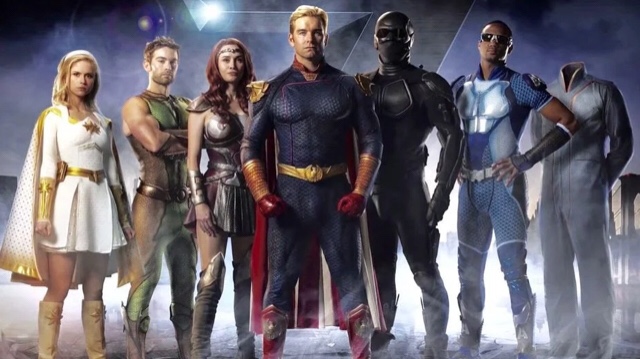
What if superheroes were real? Released in July of 2019, Amazon Prime’s binge-worthy black comedy The Boys (based on the comic of the same name) answers this very question. Unlike the show Watchmen and the movie The Incredibles, which tackle the idea of “good” superheroes being treated like criminals, The Boys takes us into a world where superheroes are callous, egoistic, and perverse while still being revered by the general public. Sound familiar? It should. What seems like a dystopian world where soulless superhumans are worshipped like celebrities is a fairly accurate representation of exactly that– celebrities. For a show famous for subverting the decade-old trope of superheroes, The Boys is a scarily accurate portrayal of our world today. Although there are tons of satire to unpack in this show, from superheroes to politics, the aspect I’ll be focusing on for this article is the portrayal of celebrity and pop-culture. Let’s explore how The Boys mocks the society we live in today.
Spoiler alert: The article will discuss some relatively important plot points from seasons 1 and 2 of The Boys.
When you really think about it, our opinions of celebrities rarely come from real experiences. Usually, our only source of celebrity news and pop-culture is either social media, TV, magazines, or newspapers. Even when you do personally meet a celebrity, it’s usually for a brief moment. You try to remember their name, you ask them for a picture, tell them about how you love their work, and that’s probably the last time you’ll see them. What we don’t usually consider is who they are behind the persona. We don’t consider the fact that there’s a huge staff, a PR team, an entire corporation who manages these celebrities’ every move. In actuality, becoming a celebrity often means you become a different person because you’re obligated to wear a mask curated by marketing professionals. In The Boys, it is the depiction of this mask through “the Seven” (a group of seven superheroes equivalent to A-list celebrities, a parody of DC’s Justice League), that makes the show such a great satire. The mask affects every superhero differently, making each character complex, yet all the more frightening.
Queen Maeve, the show’s equivalent of Wonder Woman, is one of the strongest superheroes in the show. She’s a symbol of justice and is one of two members of the Seven who is truly moral. Additionally, Queen Maeve is bisexual. In the first season, Maeve is forced to hide that part of her life from her colleagues and fanbase, for the sake of her persona and the protection of her partner. In season two though, she is involuntarily outed as a “gay hero.” When the news breaks, Maeve’s popularity amongst the population skyrockets, leading Vought to play up her sexuality for an increase in ratings. To appeal to the LGBT+ demographic, Maeve becomes the face of the pride movement. Despite being bisexual, she is labeled a lesbian because “lesbian is an easier sell.” She’s put on products and advertisements as “Brave Maeve”. Her partner is implored to wear men’s clothing because people are “more accepting of gay relationships when they’re in a clear cut gender role relationship.” Although this may seem almost hyperbolically deceptive, there have been instances of this in real life. The intolerance of homosexuality in entertainment industries has been present for a long time, from Ellen DeGeneres to Kristen Stewart, and The Boys took the opportunity to address that through Queen Maeve’s character.
Starlight (who doesn’t really have a DC or Marvel equivalent, but she can control light and electricity!) is the newest member of the Seven and represents the earlier stages of being a celebrity. Her character demonstrates how your life and personality changes with fame, and specifically focuses on what its drawbacks are. Starlight is the second member of the Seven considered to actually be “good”. Perhaps more blatant though, is how she is portrayed as innocent and pure. Then, she is coerced into changing her hero costume into a more revealing, sexually explicit outfit. Although it seems highly perverse, the incidents are nothing new. The portrayal of Starlight can be considered commentary on the experience of many celebrities who became famous at a young age, like Britney Spears, Justin Bieber, and Miley Cyrus. At first, they were marketed as cute, wholesome little kids, but became heavily sexualized by the media and magazines later on.
A-Train (the only Black member of the Seven and blessed with superhuman speed) represents the plight of a celebrity athlete. Famous for being the fastest man in the world, A-Train also struggles with substance abuse and insecurity. As an athlete, especially an athlete revered for his position at the top, A-Train is subjected to serious anxiety about his reputation and image. Consequently, he consumes a performance-enhancing drug that strengthens his powers but at the cost of weakening his bones and heart. Despite the serious side effects, A-Train is addicted to them because they help him keep the status he is so anxious about losing. In addition, A-Train’s identity as a Black man allows the show to demonstrate the concept of “tokenism”, which refers to the performative inclusion of people from under-represented communities. A-Train is marketed with all the stereotypes of Black people in the media, to the point where he is forced to perform a braggadocious rap song that was actually written by middle-aged advertisement agents. We all know the concept of celebrity athletes taking performance-enhancing drugs is nothing new, and the token representation of Black people had been very evident in mainstream media until recent years.
The Deep, equivalent to DC’s Aquaman, shows us how fame can warp one’s sense of right and wrong. Shown to be a handsome heart-throb and adored for his good looks, the Deep is conditioned to believe he can treat women however he wants. But when allegations of his sexual misconduct come to light, the character demonstrates the downfall of one’s celebrity status as well as the depression and self-esteem issues that come from being “washed-up”. Reports of sexual misconduct in the entertainment industry are nothing new, but the awareness was particularly widespread in 2017, due to the virality of the #MeToo movement. The Boys uses its platform to address how common the occurrence is but also demonstrates how easily celebrities can get out of it as well as the impacts it has on their mental health.
Lastly, the Homelander: Leader of the Seven. He is the strongest superhero in the world and a parody of DC’s Superman. Homelander is a representation of almost everything wrong with fame, celebrities, and pop culture. Initially, the show leads us to believe he is the embodiment of all heroic attributes: He’s charismatic, kind, courageous, and extremely powerful. However, it’s quickly established that all those attributes are simply a PR managed facade, and the real Homelander is very disturbed. The majority of the public is enamored by Homelander, and the constant adoration leads to him withholding a seriously narcissistic and sociopathic mentality. He faces no consequences for his wrongdoings, and as he puts it so eloquently: “I’m the Homelander, and I can do whatever the **** I want.” These kinds of attitudes are exhibited by many celebrities, primarily those at the top. Of course, Homelander is clearly an exaggeration, but his personality closely resembles that of many celebrities who believe they are above everyone else. He is the embodiment of everything wrong with the entertainment industry.
In many ways The Boys shows celebrities to be equally, both the beneficiaries as well as victims of their fame and success, and warns us of the dark side of our celebrity obsessed culture. Although it may seem easy to blame “the privileged, rich and famous elite” for the various excesses they often do indeed display, we all happily participate in idolizing, worshipping and showering with constant attention these human beings like any other. Perhaps it’s time to now question not just those celebrities who have disappointed us through their narcissism, megalomania and abuse of power, but also the culture that produced them.
 The Candid Contrarian