In a day and age where the majority of our interactions happen through social media, it becomes paramount to consider its effects on ourselves, on society, and our future. In an eye-opening documentary by Netflix, named The Social Dilemma, former employees of major Silicon Valley tech giants discuss in-depth how these platforms work and what they’re designed to do. On a personal level, this documentary really hit home for me. I spent hours truly contemplating it, and eventually decided to delete my social media accounts on Instagram, Snapchat, and Reddit.
The documentary analyses the dilemma around social media, which is how much should we be using it and at what cost? To me, it was never really a dilemma, it just became a mind-blowing experience which left me with one thought; I need to do something about it.
How Do Social Media Platforms Work?
If you think about it, social media sounds too good to be true. They’re free platforms that connect millions of users worldwide, where everyone has the ability to send messages, images, and videos to anyone, and at whatever time, and for however long. So what is really happening here? Well, as the documentary puts it rather bluntly; the platform isn’t the product, we are the product. Our data is used to generate models that can predict our behaviour. This nearly guarantees advertisers that their advertisements will be seen by the right people, at the right time, and with the highest possibility of success. And with every click we make on these platforms, the models just get more data to learn from, and become more accurate. But that’s not all.
We’re not just being sold; we’re being manipulated into giving these companies more and more of our information, endlessly feeding into their machine learning algorithms and helping them make even more money. What this means is that the more time you spend on a platform, the more money they generate. This results in one of their primary directives being engagement time, and this is the part where it gets unhealthy and unethical.
The Effects of Social Media: Society
Due to the endless scroll feature, there is no limit to the amount of time we can spend on these networks, and it’s not only that, but the content that gets shown to you that also gets decided by them. The models that they generate from the data can predict what sort of content will keep you on there for the longest period of time. That’s why it is so easy to get caught into YouTube rabbit holes, and spend hours mindlessly scrolling. The people who designed these platforms, some of them questioned the ethics of this, they wanted to create a way to prevent people from mindlessly scrolling. And they mostly ended up leaving their companies, and some of them have created this documentary. They have also talked about the potential dangers this can have to society, some of which are being realized today.
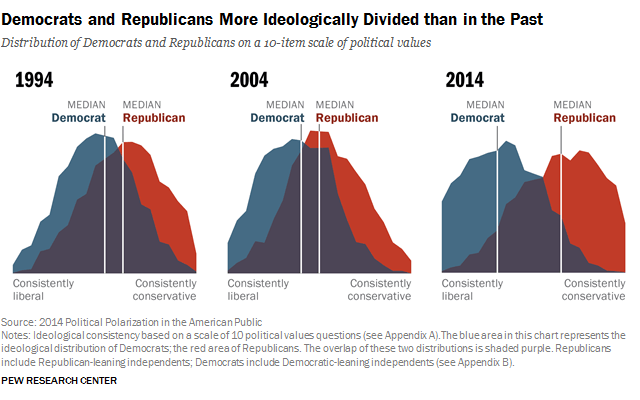
When we take a look at the content that they choose to show you, they tend to be thinks that please you and are satisfying. They have absolutely no reason to show you something that may go against your socio-political views and/or beliefs. This is one of the major causes for the increasing polarization and radicalization in the politics of today’s society. For example, this graph shows the difference in the views between the left and the right wing, and its something that has never been seen before.
This effect only gets scarier when we consider that these exact algorithms are being applied to news feeds. Earlier, everyone would get shown the same set of headlines, opinion columns, etc. This would allow people to get exposed to a multitude of perspectives and ideologies. One would think that with all of the information on the internet, we’d be able to have unbiased and well founded opinions. But that’s just not the case. The idea of tolerance is getting weaker, not the tolerance of people, but other people’s ideas. And if you’re screaming saying that the other side is stupid, idiotic, and ignorant, its just a testament to what they’re saying about social media. The only real way to get out of this issue is to seek discomfort. Look for contrasting ideas, because oftentimes they can tell you a lot more about the issue than just reading the same perspectives over and over again.
The Effects of Social Media: Individuals
The downsides of social media in terms of mental health are well-known yet little is done. Sure, there are many anti-cyberbullying and support groups, but they aren’t that effective. Oftentimes the negative effects don’t happen from people saying things about you, but from a lack of them. Not getting enough likes, views, comments, etc. And there can’t really be a “like everything movement”, or a “give attention movement”. The problem is that the attention you receive is heavily dependent on the same algorithms used to show you content. The more followers you have, the more the algorithm thinks that other people like to see your content. And if you just happen to be an introvert of a private person, you may not receive as much attention.
There is no ‘getting rid of it’, as social media has become an intrinsic part of ourselves and our communities. Communication is so reliant on WhatsApp and direct messaging that going without them would be like living under a rock. These companies have established such an important role in our lives that it becomes really difficult to get over their addictive nature.
The Solution?
This isn’t going to be an easy one, the dopamine release of the instant gratification in social media makes you associate pleasure with its usage. And so like with any addiction it is tough to combat it. But what makes it even harder is that it isn’t taboo. With cigarettes and other recreational drugs, people around you encourage you to stop it, there is stigma against it (regardless of whether it’s right or not, it makes it easier to beat the addictions), and most importantly you can surround yourself with people who don’t do it. For a teenager, no having social media is like not having a smartphone, which in itself says a lot. It has gotten to the point where our very language has included its importance. But there are still ways to do it.
Personally, I’ve deleted Instagram for the most part, and instead I use an alternative app called Threads. It’s created by Instagram, but it only has the DMs and close friend stories. This prevents me from going on the endless Instagram scroll sessions but lets me stay in touch with people as well. In terms of facebook and snapchat, I never really used them in the first place, but I found that a good place to scroll through media while still being a little productive is Reddit. Like the others it is also still quite bad, but you can choose subreddits to see the things you want to want to see, and not the ones you end up seeing on Facebook. In terms of combatting the societal effects, Qwant is an alternative search engine which doesn’t keep your data. Like a permanent incognito mode and a completely unbiased search result. Furthermore, if you still want to keep Instagram, Facebook, etc. Following other accounts with different perspectives can be beneficial. For example, if you tend to follow liberal ideologies, take a look at PragerU or some conservative leaders. While it is important to still understand that these, like any other political account, are biased, they have their merits in that you could see the other side. This will inadvertently increase tolerance and unity through understanding. When you understand where someone is coming from and what their perspective is based on, it becomes ar easier to have a productive conversation which benefits all parties.
I know that this article is a little end-of-the-world-ish it’s not completely horrific either. Social media has helped with many things, primarily connecting so much of the world. My main point is that it’s always considered to be a good thing, whose negatives are known but are ignored. Not because they’re invalid but because they’re inconvenient truths. But like any coin, social media does have two sides too.
 The Candid Contrarian