
The unprecedented rally of GameStop stock over the past 10 days in a buying frenzy orchestrated by retail traders on the social media platform Reddit, particularly r/WallStreetBets (a Reddit community with millions of aggressive day traders) has taken the investing world by storm. By pushing up the price of this failing company, they have launched it into the Fortune 500 list, caused multi-billion dollar losses to institutional investors and hedge funds with massive short positions against GameStop, and triggered a short squeeze further driving up the price. What does this all mean, and are we witnessing a bottom-up revolution of the everyman against the elite?
Let’s start with GameStop, and understand why exactly a declining video game & consumer electronics company, that was losing revenue and market share to the online market, on the verge bankruptcy, is the centre-point of one of the largest rallies in Wall Street history?
In the beginning of January, in an effort to turn-around the corporation, there was a comprehensive change in leadership and management of the company, causing a small boost in investor confidence and optimism in the markets. Wall Street hedge funds, saw through this temporary rally, and based on the fundamentals of the company, predicted that it’s stock prices would eventually fall. To profit off of this prediction many of these hedge funds built up something known as a short position against the company, speculating and betting that as it declined, it’s stock prices would dramatically fall, thus allowing them to earn a profit. Let’s side track shortly, and explore how shorts works. Say the price of a stock is $100, but a trader has reason to believe that it’s price will fall to $50 and wants to profit off of this prediction. A trader borrows this stock of a company worth $100 and then immediately sells them. The stock’s price falls to $50 as the trader had predicted and so he now buys the stock back but at this lower price, and repays his initial loan with this stock. As a result he pockets the difference between the price he had borrowed and sold it for compared to the price he bought it at to repay it, thus making $50. However, here’s the catch: unlike investing long where an investor buys a stock with the hope that over time it’s value increases, a short-seller is exposed to infinite risk if his bet turns out to be wrong. An investor going long only stands to lose the money he initially invested, but a short-seller may borrow a share at a certain price say $100, sell it, and then see the price go up to $500, or a $1,000, or $10,000 with the obligation to repay his loan at that price.
Now, enter the Reddit community of options traders known as r/WallStreetBets. Just after hedge funds shorted GameStop, acute observers and intelligent traders noticed something big. Really, really big. Hedge funds had shorted more than 90% of the company’s available floating stock; hedge funds got greedy, they did not expect any shenanigans, and were absolutely assured that any movement in the price of stock would only be in one direction. Down. Any significant increase in GameStop price this Reddit community observed, would trigger a margin call, a market action where short-sellers (i.e. the hedge funds) are asked to double down or “cover” their short position by buying a required level of their shorted stock to assure their lender of their ability to repay it. In essence, Reddit had just discovered a nuclear weapon, to level hedge funds to the ground. In the event a company has it’s total floating stock shorted to the extent that GameStop did, if there is sudden new demand for shares increasing price, short-sellers would be forced to bid each other to oblivion fighting to buy shares to cover their wide open short position.
When trading began on the New York Stock Exchange the morning of Wednesday, January 27th, GameStop stock price was already unreasonably high, unchained to any of the company’s fundamentals the beginnings of a short squeeze already underway, but within a half hour of trading, the true depth of the squeeze was unleashed. A stock that should’ve been worth close to nothing shot up over a 1000% reaching a peak of over $400.
Simply put, these hedge funds did not foresee any external factors, and it was only through the collective action of hundreds of thousands of Reddit users and small investors that they were able to trigger a short squeeze, forcing Wall Street to liquidate their short positions in a mad dash to recover stock.
January 27th, was a turning point, and this is when the absurd price surge of GameStop stock price reached public notice. With endorsements from high-profile figures such as Elon Musk and Mark Cuban, millions of small investors such as those from r/WallStreetBets refused to sell their stock at it’s peak, and held even when the price dipped. “Hold the line!”, has become a rallying cry online, with small traders determined to fully unleash the short squeeze and make big hedge funds pay for their market manipulation and greed, by letting the price of the stock just keep going up. Collective action is of utmost importance, and this is the one hope hedge funds still have. If individuals decide to cash out when they stock reaches higher and higher peaks, it may cause a chain reaction in the market, where traders panic-sell stock as they see the price dip due to others sales.
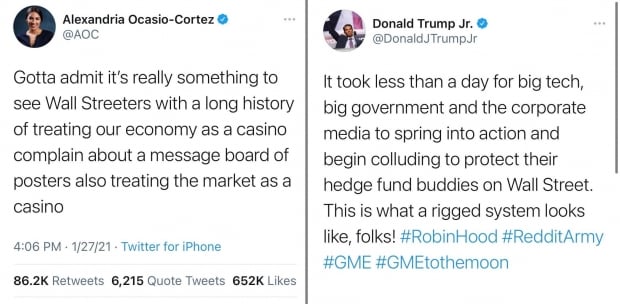
And this is not all. In a desperate attempt to prevent the stock price from surging, online brokerage firms such as Robinhood which are the most commonly used online trading platforms for small investors, froze buy orders for GameStop stock at it’s height. In a highly criticised move where the true power of institutional investors were seen, the market tried to collude in an attempt to prevent this short squeeze. At this point everyone from left-liberal politicians such as AOC, and even far right activists like Donald Trump Jr. where united in their condemnation of companies like Robinhood.
Over the year 2020, as this particular Reddit community WallStreetBets grew in popularity, the ridicule and resentment felt for the elite institutional investors who made billions on the stock market while ordinary people lost their jobs due to the COVID-19 pandemic also increased. Bitterness with Wall Street is nothing new, and since the 2008 financial crisis, when Wall Street got away scot-free from the consequences of their bad practices, and high risk securitization/derivatives-manipulation that caused a recession in the world economy, it’s no wonder why. Everyone likes a Rocky-style, underdog, David vs. Goliath story; the everyman against the gigantic, faceless, hedge funds and banks that run Wall Street. So, what started as a joke stock pick, GME or GameStop, became the instrument for the ordinary man to get back at the elite, culminating in what is now possibly the greatest prank yet also the greatest coordinated mass market manipulation in the history of Wall Street.
 The Candid Contrarian