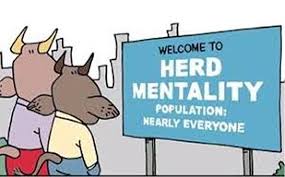
In individuals, insanity is rare; but in groups, parties, nations and epochs, it is the rule.
Friedrich Nietzsche
Our conception of what is beautiful, what is aesthetically pleasing, what art, music or poetry is worthy of appreciation, should ideally be instinctive, something you are not consciously aware of. The subconscious nature of the feeling it evokes, should be pure, simple and authentic. This doesn’t mean an individual has to forego nuance, mixed feelings, and deliberation, but the problem arises when the questions about beauty we ask ourselves shift from, “Do I really like this?”, to, “Am I supposed to like this?”.
Conformity to our social groups, popularly known as the idea of the herd mentality, give us security. We are ultra-social creatures, and have deeply held evolutionary desires to be socially acceptable; in our vast evolutionary history being outcast from the group was often a death sentence. It is only natural that our deep seated instincts towards conformity should rise even in our aesthetic tastes, taking cues from our peers.
It is easy to find examples throughout nature of the idea of strength in numbers, suggesting that the herd will protect you. We intuitively understand why one lion can’t hope to take on a herd of bison, even though this predator could take on each individual, separate from the group; this is the clear advantage to herds and the reason us humans evolved to be tribal creatures.
In a popular thought experiment conceived by the economist Robert Shiller, regarding this notion of herd mentality, let us explore a scenario in which customers have to choose between two new restaurants. These restaurants are located next to one another, and nobody has heard of them. The first customer walks up to both of them, and he picks the first one. This decision could be because he may have found the first one to be more aesthetically pleasing, thus he made his decision based on internal information, that is, the observations he made about both restaurants. A second customer then walks up to both restaurants, and she also chooses to go to the first one. The difference here is that she may have made her decision with two types of information. She received the same kind of internal information, but she also received external information, which is based on someone else’s decision. She could have assumed several things, but what she saw is two restaurants, one with a customer and one without. Even if she found the second to be more aesthetically pleasing, she might have went with the first. This is simply because in this time of uncertainty she valued someone else’s decision over her own. Then a third customer walks up to the restaurant, and I think you understand where this is going. What ends up happening is that people choose to ignore their own internal information, and completely rely on someone else’s decision as a proxy for real knowledge, despite the possibility that the alternative be better. The assumption that everyone ends up making is that the person before them has made an informed decision when in reality no one has, and the first decision in this long chain may have been arbitrary and slightly random.
This thought experiment is an idealistic situation. In the real world, marketing strategies, innovation, etc. will make it such that there will be a lot more internal information to process. However, there are times when the crowd can be helpful, for example, reviews from popular websites like Yelp and Zomato play a large role and aid us in our decision making. But understanding a situation like this is extremely important. If we start to become more aware of the difference between our internal information, and external information, we can start to make our own decisions.
Social Identity Theory
We’ve gone over how sometimes our decisions are manipulated by other people, and now we can take it a step further i.e. our identities. A social identity is how we define ourselves based on the groups we are a part of. These social identities can be defined and are closely related to herd mentalities. When we create an identity based on a group, it makes us feel we are truly a part of the group and gives us this sense of belonging. This idea also plays into stereotypes, and whether you like it or not, the human brain tends to group things.
These identities are defined by two things, in-group and out-group. The former is a tendency to mimic and replicate the similarities within the group, and the latter is about the differentiating and distancing ourselves from other groups. This tendency to categorize people makes it easier for us to decide who we want to be. Each of these categories has attributes assigned to them, and when it gets out of hand it can lead to discrimination and prejudices. But these attributes make it easier to become the person we believe would be part of a group. And the selection of the group we want to be in is based on self-categorization.
This self-categorization considers multiple things. For one, it briefly considers your own attributes, but more than that it looks at our desires. Who we would like to be, or who we think is ‘cool’. As this process of self-categorization happens, we select a group, and thus the transformation begins. Eventually, we tend to forget how or why we changed, and just pass it off as ‘its a phase’ or ‘its part of life’. Whatever it is, it may be time to self-reflect and see who you really are. And every time we make a change to be that someone, we lose a part of ourselves. Aside from this dark turn into this deep pool of self-contemplation and a chance at your latest existential crisis, there are other by-products of this too.
As these groups start to solidify and become either more exclusive or diverge from the rest of society, we start to compare ourselves, and in turn, compare our groups. Our self-esteem is heavily reliant on the status of our group, and we need our group to be the best. And thus the competitions begin. These competitions could describe a multitude of major conflicts of history, and a lot of smaller day-to-day conflicts as well. That’s the thing about these groups, we stop judging ourselves based on our capabilities, and begin to define ourselves by the status of the group.
The Sheep and the Killer Lambs
In a study conducted by the social psychologist Jonah Berger, he looked into why people choose to diverge from the norm. This looked into individual preferences and divergences within groups (in-group). These studies describe mild versions and natural versions of moving away from the herd.
In this study, participants were asked to pick a new car. The participants received information about these cars (internal information), and also received a list of the kind of people that bought these cars (external information). Out of a group of 100 similar people. The first car, a black BMW, was picked by 60 people. The second car, a silver BMW, was picked by 20 people. And the other 20 picked a black Mercedes. Simultaneously, they interviewed each participant about their need for uniqueness and found that those with the highest needs for uniqueness tended to pick the silver BMW. These participants still picked the favourite brand of their group but chose to go with a different colour. This made it possible to distinguish themselves as individuals, but still, pick something that the rest of the group did.
A secondary study made participants pick between brands of paper towels, detergent, clothes, and music. Before making their selections they were told the choices of an older person. Additionally, they were also told that a peer would witness these results. The study showed that the participants were 10% more likely to pick the same paper towels and detergents as the older person. And 15% less likely to pick the same music and/or clothes. While this doesn’t seem that fascinating, understanding why connects us right back to aesthetics. Music and clothes are somewhat of identity signalling decisions. These are personal preferences, which in some way affects our identities, or at least how we perceive how others perceive our identities.
These two studies kind of show what it means to be an individual within a group. And describe to some degree, why and how we try to be unique while still conforming to some sort of group identity. This is very common and not at all destructive. It sits in this perfect balance, which gives us the best of both worlds. And like with everything touched by time, it has reached an equilibrium of sorts.
Now, there are a few special individuals that disturb this delicate balance. These are the killer lambs. They come in all forms, but they have one thing in common. They tell you what you can like and cannot like. And that bothers me. In what world can someone tell me I’m wrong to like a song. There is a line, and after a point, these ‘opinions’ start to become something far more malicious. These killer lambs shepherd a new herd, and these herds are honestly worse than the main herd. It comes in many forms, like listening to only rage core! Or hey that song by *insert pop artist* is overrated! (I did a whole separate piece on this effect in music). The point is that they have this prejudice against the herd, for the sake of being against the herd. The reason why could be because they believe its ‘cool’ to do so.
My favourite example of these kinds of people is edgelords. In their quest for the eternal glory of edginess, they promote a complete disregard for social norms. Demonstrating complete indifference to everything normal, but indulging and promoting all things gory and disturbing. And when you choose not to indulge, you’re told that you’re basic and a multitude of other things. I don’t have a thing against edgelords, but only when they start to impose their ideas on others. Now after this even darker turn, the second kind of person that breaks away from the herd is the one I admire most.
A key thing to note here is that he does not intend to say be different. But have the capacity to do so. It means being an individual, to be a higher man, you don’t have to be different, but be you. Be an individual who at times may follow the herd, and at times follow the killer lamb, and at times neither. But whomsoever it seems like you choose to follow, you are following you at all times.
In that last study, the choices made for the detergents and paper towels didn’t matter (at least in terms of identity). These were what we can call neutral decisions. A choice in which the peer would find inconsequential towards your identity. But when it comes to art, every decision you make says something about you. We follow the herd when we are uncertain because it provides us with security. And sometimes we even ignore our instincts and value the herd’s choice above ours. Then there are times we feel the need to be completely different, and possibly get influenced by the killer lambs.
Our aesthetic sense and preferences are extremely vulnerable to these external factors because there is no neutral decision when it comes to art. Each and everything you choose, says something about you. And that is a daunting thing and makes it desirable to play it safe. People talk about expressing themselves through art, but in a way, we express ourselves through our preferences within art.
Art is such a thing that there is nothing that compares to it. There is no alternative form of art, it is solely one and unique. It is what makes our communities civilizations, but it presents us with a unique opportunity. Here’s the thing about being a contrarian, it isn’t about contradicting everything as the name suggests. But it’s about an open and welcoming perspective, to all things new, and all things you. Being the higher man doesn’t mean being better than everyone else, but choosing to take a stand. And since we are most vulnerable when it comes to art. Here is where you can take a stand, and truly figure out who you are, and not by defining yourself in terms of anybody else, or any group.
 The Candid Contrarian
Very interesting read, and I think that the experiments conducted speak for what I could say. I think that there is nothing wrong with following trends if you like that, but it is also good to keep your sense of individualiy.
LikeLiked by 2 people